Disclosure: Some links in this article are affiliate links. We may earn a commission on qualifying purchases at no extra cost to you.
The first time I checked a PM2.5 monitor during a smoke advisory, I expected the number to look bad. I didn't expect it to look worse indoors than the "moderate" reading my phone was showing for the neighborhood. That gap — between what the outdoor air quality index says and what's actually floating around in your living room — is where most of the confusion about PM2.5 and air purifiers starts.
PM2.5 gets thrown around constantly in air quality apps, wildfire alerts, and purifier marketing, but most people never get a straight answer to the two questions that actually matter: what is this stuff, and does a HEPA purifier really catch it? The short version is yes, a properly sized True HEPA purifier is one of the most effective tools you can put in a room for PM2.5. The longer version — the physics of why, the marketing terms designed to confuse you, and the sizing math that determines whether your specific purifier is doing anything at all — is worth twenty minutes of your time if you're about to spend money on one.
This guide walks through what PM2.5 actually is, why it's more dangerous than larger dust particles despite being invisible, how HEPA filtration physically deals with something that small, and which purifiers are worth buying if PM2.5 reduction is your actual goal — not just "clean air" as a vague marketing promise.
It's built for anyone dealing with wildfire smoke seasons, city pollution, a smoker in the house, or just a nagging feeling that "air purifier" is a broader category than it needs to be. If you already own a purifier, the sizing section alone may explain why it isn't doing what you expected.
Quick Reference: PM2.5 at a Glance
| Term | What It Means |
|---|---|
| PM2.5 | Particulate matter 2.5 microns or smaller in diameter |
| PM10 | Particulate matter 10 microns or smaller (PM2.5 is a subset) |
| Human hair (for scale) | ~70 microns — roughly 30x wider than the largest PM2.5 particle |
| EPA annual standard (since May 2024) | 9.0 µg/m³ |
| EPA 24-hour standard | 35 µg/m³ |
| WHO annual guideline (2021) | 5 µg/m³ |
| WHO 24-hour guideline | 15 µg/m³ |
| True HEPA definition | Captures 99.97% of particles at 0.3 microns (the hardest size to catch) |
| Common indoor sources | Cooking (frying, grilling), candles/incense, tobacco smoke, wood stoves, infiltrated outdoor pollution |
What PM2.5 Actually Is (and Why It's Different from PM10)
PM2.5 refers to fine particulate matter — any particle 2.5 microns or smaller in diameter. PM10 is the broader category, covering anything up to 10 microns, which makes PM2.5 a subset of PM10, not a separate kind of pollution. For scale, the average human hair is about 70 microns across — roughly 30 times larger than the biggest particle that still counts as PM2.5. You cannot see individual PM2.5 particles; what you're seeing during a smoky or hazy day is the cumulative effect of billions of them scattering light.
The size is exactly why PM2.5 matters more to your health than larger dust. PM10 particles get filtered out by your nose and upper airway before they ever reach your lungs. PM2.5 is small enough to bypass that defense, travel deep into lung tissue, and in some cases cross into the bloodstream. That's the mechanism behind its association with cardiovascular disease, aggravated asthma, and increased mortality risk in long-term exposure studies.
Indoors, PM2.5 doesn't require an external event like a wildfire to show up. Frying or grilling food, burning candles or incense, tobacco smoke, and wood-burning stoves are all common indoor sources — and if your home isn't sealed particularly well, outdoor pollution infiltrates too. That's the practical reason PM2.5 is a year-round concern rather than a seasonal one, even if wildfire smoke is what puts it on most people's radar.
How HEPA Filters Actually Catch Something This Small
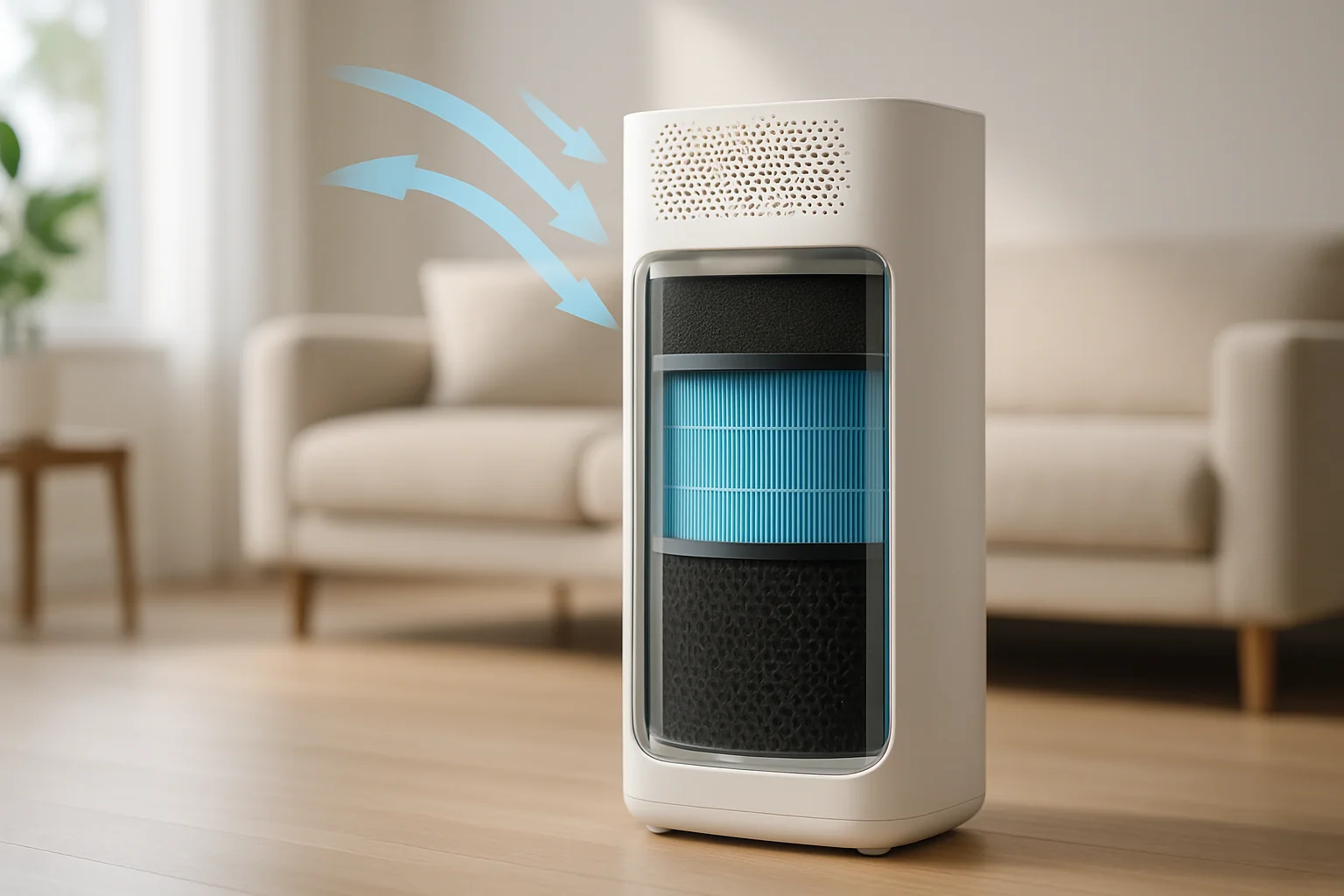
Here's the part that trips up most buyers, including people who've owned a purifier for years: HEPA filters aren't a sieve. They don't work by having holes smaller than the particles they catch — if they did, PM2.5 would sail straight through, since a mesh fine enough to physically block a 2.5-micron particle would clog with dust in hours and choke off airflow entirely.
Instead, HEPA media relies on three separate capture mechanisms working at once. Larger particles get caught by impaction — they're moving in a straight line, can't follow the air as it curves around a fiber, and slam into it directly. Mid-size particles get caught by interception — they follow the airflow closely enough to brush against a fiber and stick. The smallest particles, the ones under about 0.1 microns, are caught by diffusion: they're light enough that they bounce around erratically due to Brownian motion, which increases the odds they'll randomly collide with a fiber rather than traveling in a predictable path around it.
This is why the often-repeated claim that "HEPA filters can't catch anything below 0.3 microns" gets the physics backwards. The 0.3-micron benchmark used in HEPA testing (Most Penetrating Particle Size, or MPPS) isn't a floor — it's the single hardest size to capture, because it's too large to benefit much from diffusion and too small to be reliably caught by impaction or interception. Particles smaller than 0.3 microns are actually captured more efficiently than particles at that size, because diffusion becomes more effective as particles get lighter. PM2.5, sitting well above the 0.3-micron danger zone, is captured with high efficiency by any filter that meets the True HEPA standard.
True HEPA vs. "HEPA-Type" — The Label That Actually Matters
"True HEPA" is a specific, testable claim: 99.97% capture efficiency at the 0.3-micron MPPS, per the US Department of Energy standard. The European equivalent, EN 1822, defines H13-rated filters at 99.95% efficiency at MPPS and H14 at 99.995%. Both are real, verifiable standards.
"HEPA-type," "HEPA-like," and similar phrasing are marketing terms with no legal definition behind them. In practice, filters carrying these labels typically capture somewhere in the 85–95% range — a meaningful step down, especially at the smallest and most penetrating particle sizes. The gap matters most in exactly the scenario people buy purifiers for: heavy smoke or wildfire events, where the sheer particle load means even a few percentage points of efficiency translate into a noticeably different indoor reading.
The label isn't even a guarantee on its own — filter and HEPA claims have faced real scrutiny. In 2023, following a formal challenge through the BBB National Advertising Division, Vesync (the parent company behind Levoit) voluntarily withdrew certain HEPA claims from marketing for several models. That doesn't mean those units stopped performing well — independent lab and community testing generally still shows strong particle capture — but it's a useful reminder that a brand's own labeling isn't the final word. The safer approach is to look for the specific numeric claim — "99.97% at 0.3 microns" or an H13/H14 rating — rather than trusting "HEPA" as a standalone word on the box.
How Much PM2.5 Is Too Much? EPA and WHO Thresholds
Regulatory thresholds for PM2.5 have gotten stricter, not looser, as the health research has accumulated. In the US, the EPA lowered its primary annual PM2.5 standard from 12.0 to 9.0 micrograms per cubic meter (µg/m³), effective May 2024, while keeping the 24-hour standard at 35 µg/m³. The World Health Organization's 2021 global air quality guidelines are considerably more conservative: an annual average ceiling of 5 µg/m³ and a 24-hour ceiling of 15 µg/m³ — literally half of the WHO's own prior 2005 guideline, reflecting how much the evidence on low-level chronic exposure has shifted.
The practical takeaway: a reading that an air quality app calls "moderate" against the older, looser thresholds can still sit well above what current health guidance considers genuinely safe for long-term exposure. If you're using PM2.5 as a benchmark for whether your indoor air is fine, the WHO numbers are the more conservative — and arguably more useful — target to aim for, especially for households with kids, older adults, or anyone with respiratory or cardiovascular conditions.
None of this is theoretical when it comes to purifiers. A 2022 study published in the International Journal of Environmental Research and Public Health measured indoor PM2.5 with and without HEPA air cleaners running and found a mean difference of −16.3 µg/m³ (33.5 vs. 17.2 µg/m³, p < 0.001) — a statistically significant, real-world reduction, not just a lab claim.
Sizing a Purifier for Real PM2.5 Reduction
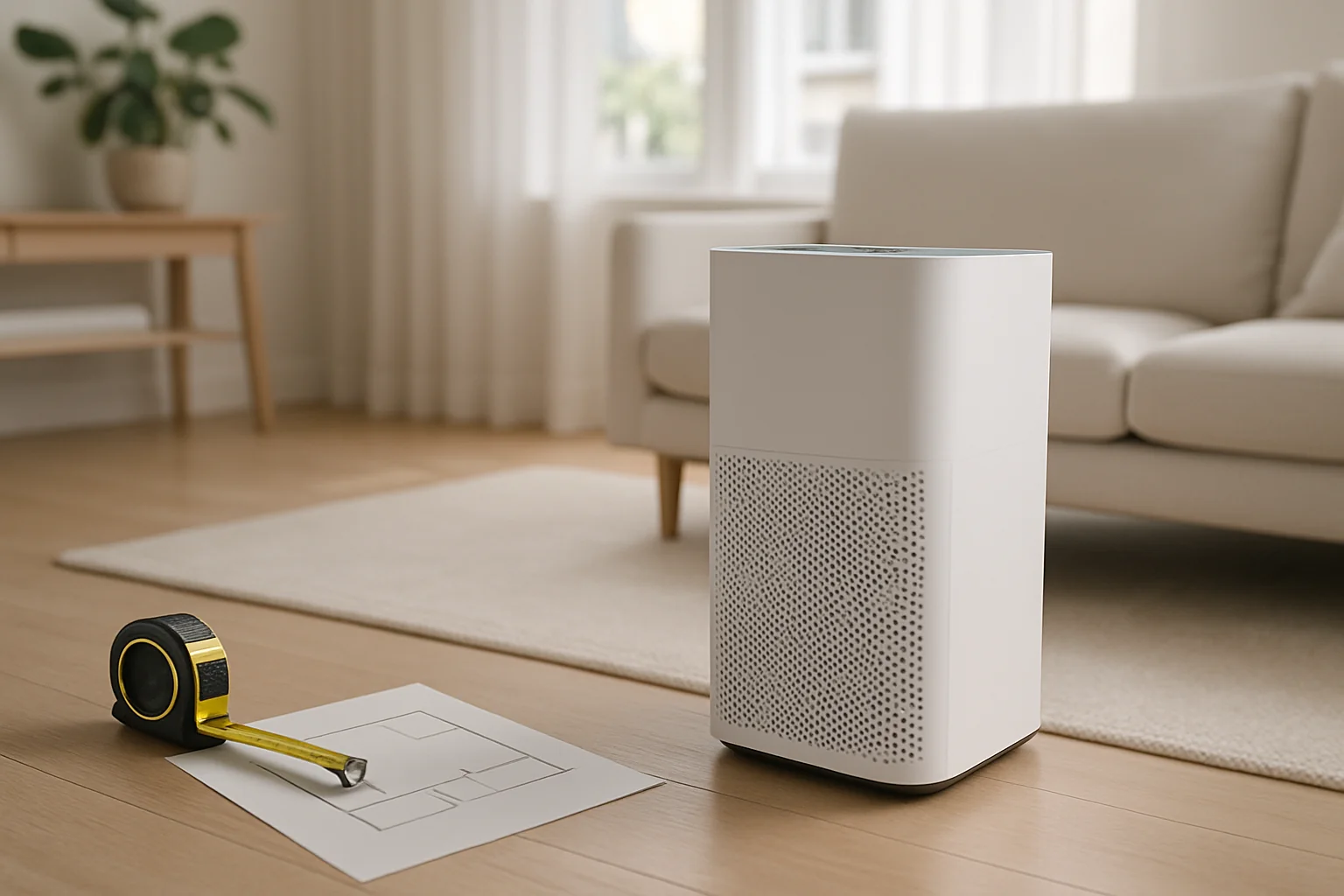
This is the step most buyers skip, and it's the single biggest reason a "good" purifier underperforms in someone's home. Manufacturers advertise room coverage numbers that are frequently generous relative to how the industry's own testing body — AHAM (Association of Home Appliance Manufacturers) — actually rates them. AHAM's coverage figures are derived from CADR (Clean Air Delivery Rate), measured in cubic feet per minute (cfm) for smoke, dust, and pollen separately.
The rule of thumb from AHAM itself: for baseline coverage, look for a CADR rating equal to at least two-thirds of your room's square footage. But for smoke and allergen-heavy situations — wildfire season, a household with pets and asthma, anyone dealing with dust sensitivity — the better target is 4 to 5 air changes per hour (ACH), which usually means sizing the unit for a room noticeably smaller than its maximum advertised coverage. A purifier rated for a 500-square-foot room at "1 ACH" is a very different appliance than one delivering 4–5 ACH in that same room, even though both numbers can appear on the same spec sheet depending on how a brand chooses to present it.
The failure mode here is buying based on the biggest square-footage number printed on the box, running the unit in a larger space than that number was ever meant to represent, and concluding that HEPA filtration "doesn't really work." In almost every case like that, the filtration is fine — the sizing was wrong.
Purifiers Worth Buying for PM2.5 Control
The picks below aren't a general best-of list — they're specifically strong choices when PM2.5 reduction, not just "an air purifier," is the goal. All use True HEPA media rated at 99.97% at 0.3 microns.
Coway Airmega AP-1512HH Mighty — Best Overall Starting Point
Specs:
- CADR: 233 smoke / 246 dust / 240 pollen (AHAM)
- AHAM coverage: 361 sq ft
- 4-stage filtration: pre-filter, deodorization (carbon), True HEPA, disable-able Vital Ion ionizer
- Noise: 24.4–53.8 dB
- HEPA filter life: ~1 year; carbon filter: ~6 months
Positioning: Budget-to-mid tier. This is the model that shows up in air quality communities more than almost any other, largely because its CADR-to-footprint ratio holds up at 4–5 ACH in rooms well under its advertised max — exactly the sizing this guide argues for.
Pros:
- Strong, independently verified CADR for its size
- Ionizer can be switched off entirely if you'd rather avoid it
- Widely available replacement filters, including third-party options
Cons:
- No smart app or PM2.5 display — you're running it on trust, not live data
- Runs louder at max speed than at low/medium
Verdict: The most proven, lowest-risk option if you want confirmed PM2.5 performance without paying for smart features you may not use.
Perfect for: Bedrooms and living rooms up to roughly 350–400 sq ft where you want a track record, not a gamble.
Levoit Core 600S — Best for Larger Rooms with Live Feedback
Specs:
- CADR: ~410 cfm (smoke, AHAM)
- Recommended room size: 635 sq ft at 5 ACH
- 3-in-1 filter: pre-filter, True HEPA, activated carbon
- Built-in laser PM2.5 sensor with real-time display, app control
- Noise: 26–55 dB
Positioning: Mid tier. The CADR here supports genuinely larger rooms at a real 4–5 ACH target, not just on paper.
Pros:
- Onboard PM2.5 sensor gives you an actual number instead of a guess
- CADR comfortably covers open-plan living areas
- App control for scheduling and monitoring from another room
Cons:
- Larger footprint, more visually present in a room than compact units
- Replacement filters run on the higher end for a mid-tier unit
Verdict: If you want to actually watch your PM2.5 number drop after switching it on — instead of trusting a spec sheet — this is the pick.
Perfect for: Open-plan living rooms, larger bedrooms, or anyone who wants live data alongside filtration.
Coway Airmega 400S — Best for Wildfire Smoke and Whole-Room Coverage
Specs:
- CADR: 328 dust / up to 376 smoke / 400+ pollen (AHAM, figures vary slightly by testing update)
- Recommended coverage: up to 1,560 sq ft at 2 ACH
- Dual Max2 filters (pre-filter, True HEPA, carbon — two full sets)
- Disable-able bipolar ionizer, app control, onboard PM2.5 sensor
- Noise: 22–52 dB
Positioning: Premium tier, built for larger spaces or heavier particle loads rather than a single small bedroom.
Pros:
- High CADR gives real headroom during smoke events, not just "clean air" days
- Dual filter sets extend maintenance intervals in high-load conditions
- Quiet at lower speeds relative to its output
Cons:
- Higher running cost — two filter sets means two replacement cycles
- Larger unit, not ideal for small rooms
Verdict: The one to reach for if you're dealing with recurring wildfire smoke seasons or a genuinely large open space rather than a single bedroom.
Perfect for: Whole-room or open-concept coverage, and households in wildfire-prone regions.
IQAir HealthPro Plus — Premium Option for Severe Sensitivity
Specs:
- CADR: ~300 cfm
- Coverage: up to 1,125 sq ft at 2 ACH
- 3-stage: PreMax F8 pre-filter, V5-Cell gas/odor carbon, HyperHEPA (tested to ≥99.5% down to 0.003 microns)
- Filter life: HyperHEPA rated for 3–4 years
- No ozone emissions; 10-year warranty
Positioning: Premium, closer to medical-grade than mainstream consumer. Worth being clear-eyed about: a standard True HEPA filter already captures PM2.5 with high efficiency — this isn't a "the others don't really work" upgrade, it's a step further into ultrafine particle territory that matters most for severe asthma or unusually high ultrafine pollution exposure.
Pros:
- Exceptionally long filter life reduces long-term maintenance
- Swiss build quality and long warranty coverage
- Genuinely tested performance well beyond standard HEPA benchmarks
Cons:
- Meaningfully higher upfront and running cost than the other options here
- Higher power draw than compact HEPA units
- Overkill for typical household PM2.5 concerns
Verdict: A legitimate option for severe asthma, chemical sensitivity, or ultrafine particle concerns — not a default recommendation for general PM2.5 reduction.
Perfect for: Households managing severe respiratory conditions or unusually high ambient pollution exposure.
Quick Comparison
| Model | CADR (smoke) | AHAM Coverage | Tier | Best For |
|---|---|---|---|---|
| Coway AP-1512HH Mighty | 233 cfm | 361 sq ft | Budget/mid | Proven all-rounder |
| Levoit Core 600S | ~410 cfm | 635 sq ft | Mid | Larger rooms, live PM2.5 data |
| Coway Airmega 400S | up to 376 cfm | 1,560 sq ft (2 ACH) | Premium | Wildfire smoke, large spaces |
| IQAir HealthPro Plus | ~300 cfm | 1,125 sq ft (2 ACH) | Premium | Severe sensitivity, ultrafine particles |
Two more worth a mention if the above don't fit your budget shape: the Winix 5500-2 has long been a community favorite for its washable carbon filter and strong CADR-to-price ratio, though availability has tightened as Winix shifts production toward newer models in the same line — worth checking current stock before committing. The Blueair Blue Pure 211+ Auto uses a hybrid electrostatic-plus-mechanical approach (HEPASilent) rather than a pure mechanical True HEPA stage; it tests to 99.97% down to 0.1 microns and is certified zero-ozone, but it's worth knowing it isn't marketed under the strict "True HEPA" designation, even though its measured performance is strong.
Check Winix 5500-2 on Amazon · Check Blueair Blue Pure 211+ Auto on Amazon
What a HEPA Purifier Won't Fix
It's worth being direct about the limits, because overselling filtration is how people end up disappointed. HEPA media captures particulate matter — it does nothing for gases or volatile organic compounds (VOCs). The lingering smell after cooking or the chemical odor from new furniture isn't a HEPA problem; it needs an activated carbon stage to adsorb it, which is why most serious purifiers pair HEPA with carbon rather than shipping HEPA alone.
A purifier also isn't a replacement for source control or ventilation. If a wood stove, a leaky range hood, or an unusually polluted micro-location is the actual source, running a purifier helps manage the symptom but doesn't address the source. And a purifier only helps the room it's actually sized for — running one undersized unit in an open-plan home and expecting whole-house results is the same sizing mistake covered earlier, just at a larger scale.
Filter maintenance matters more than most people expect, too. A True HEPA filter that's overdue for replacement doesn't fail outright — its efficiency degrades gradually, and a purifier with a clogged filter often just moves less air overall, which quietly undercuts CADR even if the media itself is still technically functional. For guidance on keeping your unit performing at peak efficiency, see our air purifier filter replacement guide.
Frequently Asked Questions
Q: Can air purifiers really filter out PM2.5?
Yes. True HEPA filters, rated at 99.97% capture efficiency at 0.3 microns, remove PM2.5 particles with high efficiency because PM2.5 sits above the hardest-to-capture particle size. A 2022 peer-reviewed study measured a statistically significant reduction of over 16 µg/m³ indoors with HEPA units running.
Q: Does True HEPA actually catch particles smaller than 0.3 microns?
Yes, and often more effectively than particles at exactly 0.3 microns. The 0.3-micron benchmark is the most penetrating particle size, not a filtration floor — particles below that size are captured more efficiently through diffusion, a mechanism that improves as particles get smaller.
Q: What's the real difference between "True HEPA" and "HEPA-type"?
True HEPA is a tested, numeric standard: 99.97% efficiency at 0.3 microns (DOE) or a comparable H13/H14 EN 1822 rating. "HEPA-type" and "HEPA-like" are marketing terms with no legal definition and typically perform in the 85–95% range — noticeably lower, especially during heavy smoke events.
Q: What PM2.5 level is considered unhealthy?
The US EPA's current annual standard is 9.0 µg/m³ (lowered from 12.0 in 2024), with a 24-hour standard of 35 µg/m³. The World Health Organization's guidelines are stricter: 5 µg/m³ annual and 15 µg/m³ for 24 hours. If you're aiming for a conservative indoor target, the WHO numbers are the more protective benchmark.
Q: What size air purifier do I actually need for PM2.5?
Match CADR to your room, not the advertised max square footage on the box. AHAM's minimum rule is CADR at least two-thirds of your room's square footage; for smoke or heavy allergen situations, aim for 4–5 air changes per hour, which usually means sizing for a smaller room than the unit's maximum rated coverage. Learn more in our air purifier room size guide.
Q: Will a HEPA purifier also remove wildfire smoke smell?
Only partially. HEPA filters capture the particulate matter in smoke, which is most of what a PM2.5 monitor measures, but the lingering odor comes from gases and VOCs that require an activated carbon stage to adsorb. Most serious purifiers, including the picks above, pair HEPA with carbon for exactly this reason.
Conclusion
The physics isn't in dispute: True HEPA filtration handles PM2.5 well, and the "0.3 microns is the cutoff" framing that makes people doubt it actually describes the hardest particle size to catch, not a wall smaller particles slip through. Where purifiers actually fail people isn't the filter media — it's the label confusion between "True HEPA" and vague "HEPA-type" marketing, and the sizing mistake of buying for an advertised square footage instead of a real CADR-to-room match.
If you take one thing from this guide, make it the sizing math — a smaller, properly matched True HEPA unit run at 4–5 ACH will outperform a larger unit that's technically rated for your room but only delivering a fraction of an air change per hour. Pair that with a carbon stage if odor or smoke smell is part of the problem, and keep filters on schedule rather than running them past their rated life.
For most households, the Coway AP-1512HH Mighty remains the safest, best-proven starting point. If your space is larger or wildfire smoke is a recurring season rather than a one-off event, the Levoit Core 600S or Coway Airmega 400S scale with you — and the IQAir HealthPro Plus is there if your situation genuinely calls for ultrafine-level filtration rather than standard PM2.5 control.