Disclosure: Some links in this article are affiliate links. We may earn a commission on qualifying purchases at no extra cost to you.
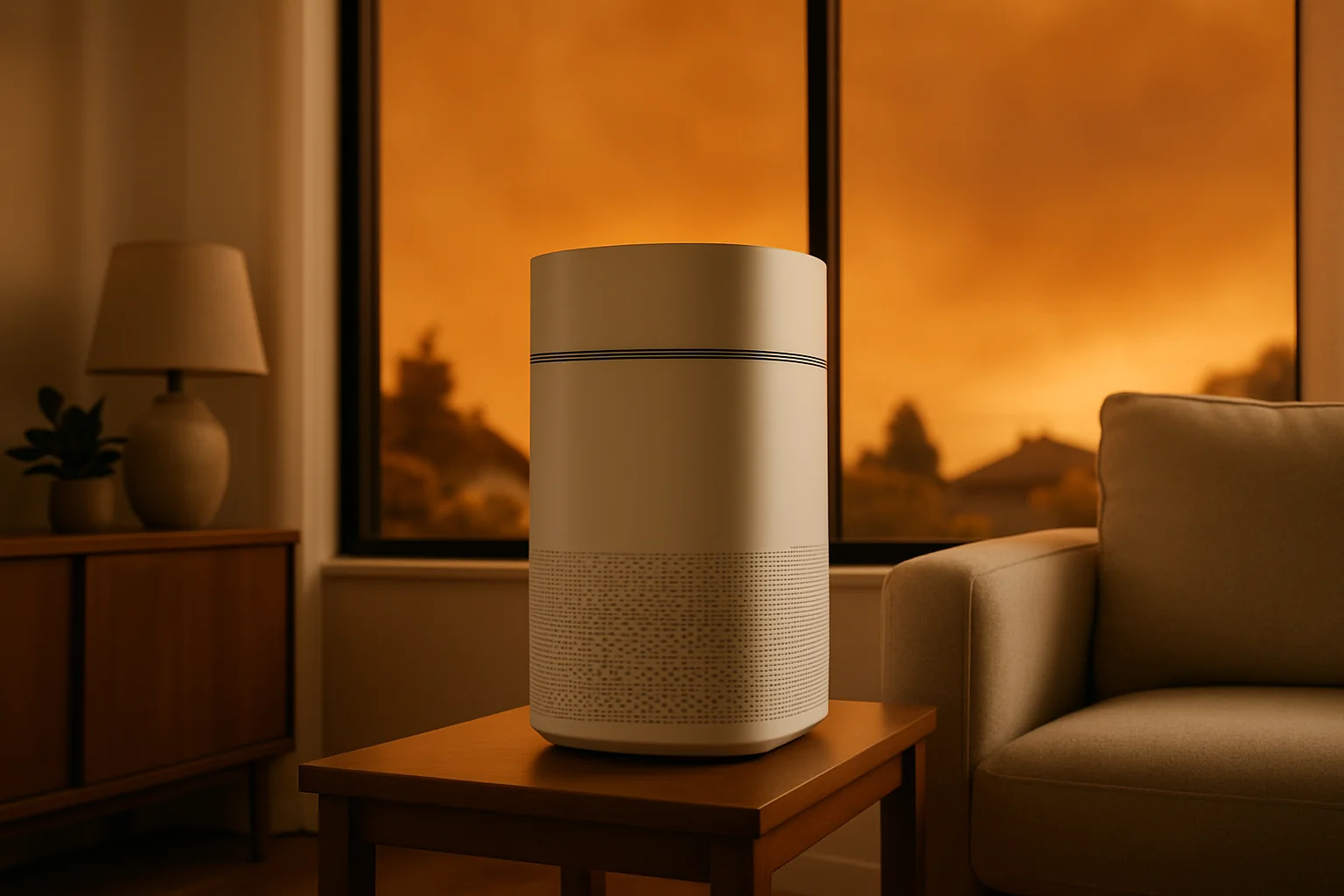
The first time smoke rolled into my valley thick enough to turn the noon sky the color of weak tea, I did what most people do: I shut every window, taped a towel under the front door, and assumed that was the fix. It wasn't. My eyes still stung by evening, and the smell of campfire lived in my curtains for a week. That's when I learned the number that actually matters for smoke isn't the big "square footage" figure on the box — it's the smoke CADR, and whether the unit has enough activated carbon to deal with the gases that HEPA can't touch.
Wildfire and household smoke are really two problems stacked on top of each other. There's the fine particulate matter — the stuff that gets AHAM's lowest, hardest-to-catch rating because it's measured on particles between 0.09 and 1.0 microns — and there's the cocktail of gases (formaldehyde, benzene, acrolein) that ride along with it and cause that lingering acrid smell. A HEPA filter handles the first. Only a real bed of activated carbon handles the second. Most buying guides quote the flashy dust or pollen CADR because it's a bigger number; we're leading with smoke CADR and carbon mass because that's what actually protects you during a smoke event.
This guide covers nine purifiers spanning budget bedroom units to a 15-pound-carbon workhorse built for people who live with chronic smoke exposure. Each pick lists its AHAM or manufacturer-estimated smoke CADR, what's actually inside the filter stack, and how fast that carbon saturates — because during a bad smoke week, the carbon runs out long before the "12-month" filter light ever turns on.
Quick Picks — Best Air Purifiers for Smoke
| Pick | Best For | Smoke CADR | Carbon Load |
|---|---|---|---|
| Coway Airmega 400S | Best overall / large room | ~328 CFM | Dual Max2 pelletized carbon |
| Coway AP-1512HH Mighty | Best value, mid-size room | 233 CFM | Bonded carbon sheet (light) |
| Winix 5510 | Best budget pick | ~253 CFM | Pellet-based carbon |
| Levoit Core 600S-P | Best large-room value | ~410 CFM | Upgrade to Smoke Remover filter |
| Levoit Core 300S-P | Best compact / bedroom | 141 CFM | Pellet-based (light) |
| IQAir HealthPro Plus | Best for VOCs / medical-grade | ~300 CFM (est.) | ~5 lb granular carbon |
| Blueair Blue Pure 211i Max | Best quiet large-room option | 410 CFM | Light carbon layer |
| Austin Air HealthMate HM400 | Best for chronic/heavy smoke | ~156–400 CFM (est.) | ~15 lb carbon/zeolite |
| Medify MA-40 | Budget H13 alternative | ~206–330 CFM (varies) | Pellet-based bonded filter |
What Actually Matters When Buying for Smoke
Before ranking anything, it's worth understanding the two numbers that should drive this purchase — because the marketing numbers on most boxes are optimized to look big, not to size your room correctly for a smoke event.
Smoke CADR is the number to trust. AHAM tests three particle classes — dust, pollen, and smoke — and smoke is tested on the smallest, most penetrating particles (0.09 to 1.0 microns). It's always the lowest of the three numbers, which is exactly why most manufacturers put the dust or pollen figure front and center. For sizing during wildfire smoke, AHAM's own guidance is specific: the unit's smoke CADR should equal the square footage of the room, not two-thirds of it, which is the rule used for everyday dust and pollen. That's a meaningfully bigger unit than most people assume they need.
Air changes per hour (ACH) should go up during an event. Daily maintenance runs at roughly 2 ACH. During an active smoke event, aim for 4 to 6 ACH — which usually means running the unit on a higher speed than you'd use on a normal day, even if that's noisier.
Closing windows helps, but it's not enough on its own. The EPA has measured that indoor PM2.5 during a wildfire event still lands around 55–60% of outdoor levels in a sealed home with no air cleaner running. Homes with central air and closed windows see smaller particle increases than homes with windows cracked open, but the gap closes dramatically once a purifier is added. The sealed room plus a running purifier is the combination that actually works.
Carbon saturates fast — faster than the filter light thinks. The "replace filter" indicator on most units is a timer, not a sensor. During heavy smoke, activated carbon can saturate in as little as eight weeks instead of the advertised 6–12 months. The real test is your nose: if the smoke smell comes back even on the highest fan speed, the carbon is spent — regardless of what the indicator light says.
A big dust CADR with a small smoke CADR is a warning sign, not a bonus. It usually means the unit moves plenty of air but struggles specifically with the fine particle range that matters most for smoke.
#1 Coway Airmega 400S — Best Overall for Large Rooms
Specs:
- Smoke CADR ~328 CFM (dust 328 / pollen 400)
- Coverage up to 1,560 sq ft at 2 ACH
- Filtration: dual Max2 cartridges — washable pre-filter + pelletized activated carbon + True HEPA, in a two-filter set for higher airflow
- Noise: 22–52 dB(A) · Power: 66 W · Filter life ~12 months
Positioning: premium / mid-premium — the unit to buy if you want one machine to cover an open-plan living space without running two smaller purifiers.
Pros:
- Dual-filter design keeps airflow strong even as filters age
- Real pelletized carbon, not a thin coated sheet
- WiFi app control and auto mode via onboard sensor
Cons:
- Large footprint, not ideal for small bedrooms
- Runs closer to $250+/year in filters and electricity if kept on 24/7
- App/WiFi setup can be fiddly on first pairing
Verdict: The 400S is the closest thing to a "buy once, cover the whole room" answer for anyone dealing with recurring wildfire smoke in a large living area. The dual-cartridge design is the real differentiator — it's built to keep moving air at volume, not just on paper.
Perfect for: open-plan living rooms, larger bedrooms, or anyone who wants a single unit to handle 1,000+ sq ft during a smoke event.
#2 Coway Airmega AP-1512HH Mighty — Best Value for Mid-Size Rooms
Specs:
- Smoke CADR 233 CFM (dust 246 / pollen 240)
- Coverage 361 sq ft at 4.8 ACH
- Filtration: pre-filter + bonded carbon deodorization sheet + True HEPA + disableable Vital Ion ionizer
- Noise: 24.4–53.8 dB(A) · Carbon filter life ~6 months · Ozone output well under CARB's limit
Positioning: mid-range value — the long-running favorite for bedrooms and mid-size living rooms.
Pros:
- Excellent particle performance for the size and price
- Ionizer can be switched off with minimal drop in performance
- Long track record and easy filter availability
Cons:
- Carbon is a bonded sheet, not pelletized — noticeably weaker on heavy odor loads than the 400S or Winix's pellet filters
- No WiFi/app control on the base model
- 6-month carbon life means more frequent replacement during smoke season
Verdict: This is the sensible default for a bedroom or standard living room, but if odor is your main complaint during smoke events, budget for more frequent carbon swaps or step up to a unit with denser carbon.
Perfect for: bedrooms and mid-size living rooms where particle removal matters more than odor elimination.
#3 Winix 5510 — Best Budget Pick
Specs:
- Smoke CADR ~253 CFM · Coverage up to 392 sq ft at 4.8 ACH
- Filtration: washable pre-filter + pellet-based activated carbon + True HEPA + PlasmaWave ionizer
- WiFi/app control · Carbon filter life ~annually
Positioning: budget — the current-generation replacement for the discontinued Winix 5500-2.
Pros:
- Real pellet-based carbon at a budget price point
- Solid smoke CADR for the price tier
- WiFi app control, which the discontinued 5500-2 lacked
Cons:
- Noticeably louder at max speed than the older 5500-2
- PlasmaWave ionizer defaults back on after a power cycle even if you'd disabled it
- Newer to market, so long-term filter longevity data is thinner than on the outgoing model
Verdict: The 5510 carries over the carbon quality that made the 5500-2 a community favorite, in a slightly noisier, WiFi-enabled package. It's the budget pick to buy new — the 5500-2 is being phased out and increasingly hard to find.
Perfect for: budget-conscious buyers who still want real activated carbon, not just a coated mesh.
#4 Levoit Core 600S-P — Best Large-Room Value
Specs:
- Smoke CADR ~410 CFM · Coverage up to 635 sq ft at ~4.8 ACH
- Filtration: pre-filter + main filter + high-efficiency activated carbon (standard ~160g; Smoke Remover upgrade filter ~360g)
- Onboard PM2.5 sensor and app control · Noise ~26 dB sleep to ~54–62 dB high · Filter life 6–12 months
Positioning: mid-range — strong airflow-per-dollar for larger rooms.
Pros:
- Very high CADR for the price
- Real-time PM2.5 display makes it easy to see the unit working during a smoke event
- Smoke Remover filter upgrade doubles the carbon mass for heavy smoke seasons
Cons:
- Gets loud on higher fan speeds
- Standard filter carbon is on the lighter side — the upgrade filter is the one to buy for actual smoke use
- Runs meaningfully higher annual filter cost if you stick with the Smoke Remover filter
Verdict: Buy this one with the Smoke Remover filter, not the standard cartridge — the base filter is fine for daily dust, but smoke buyers should budget for the upgraded carbon from day one.
Perfect for: larger bedrooms and living rooms where you want visible PM2.5 feedback during an event.
#5 Levoit Core 300S-P — Best Compact Pick for Bedrooms
Specs:
- Smoke CADR 141 CFM (dust 156 / pollen 175) · Coverage ~219 sq ft at 4.8 ACH
- Filtration: pre-filter + pellet-based activated carbon + main filter
- Noise as low as 22–24 dB on sleep mode · Filter life 6–8 months
Positioning: budget/compact — the pick for a single bedroom or home office.
Pros:
- Extremely quiet on sleep mode, genuinely unobtrusive overnight
- Good particle clearance for its size in independent testing
- Toxin Absorber/Smoke filter variant available for heavier odor loads
Cons:
- Smoke CADR of 141 CFM means it's sized for a bedroom, not a living room, during an actual smoke event
- Standard filter's carbon is light — swap to the Smoke/Toxin Absorber variant if odor is a concern
- No onboard PM2.5 display on this trim
Verdict: This is the right-sized pick for a single room, not a whole-home solution. Pair it with the Toxin Absorber filter variant if you're dealing with recurring smoke rather than occasional haze.
Perfect for: bedrooms, nurseries, and home offices where quiet operation matters as much as filtration.
#6 IQAir HealthPro Plus — Best for VOCs and Chronic Sensitivity
Specs:
- Smoke CADR ~300 CFM (manufacturer estimate; IQAir does not publish AHAM figures)
- Coverage up to 1,125 sq ft
- Filtration: PreMax F8 pre-filter + V5-Cell gas/odor filter (~5 lb granular activated carbon with chemisorption media) + HyperHEPA (H12/H13, rated to 0.003 microns)
- Filter life: HyperHEPA 3–4 years, V5-Cell ~2 years · Noise ~32–67 dB across six speeds · Swiss-made, 10-year warranty
Positioning: premium/medical-grade — built for people managing chemical sensitivity or heavy, sustained VOC exposure.
Pros:
- The largest true gas/odor filter in this roundup outside the Austin Air
- Long filter intervals reduce ongoing maintenance
- Each unit is individually tested with a certificate before shipping
Cons:
- High upfront cost and meaningfully higher running cost at higher speeds
- No AHAM-verified CADR, so sizing relies on manufacturer/third-party estimates
- Overkill for a typical single-room smoke season
Verdict: For someone managing chronic smoke exposure, multiple chemical sensitivity, or a home in a heavy wildfire corridor year after year, the V5-Cell's carbon mass is a genuine step up from the pellet or bonded-sheet filters used in most consumer units.
Perfect for: chemical sensitivity, chronic wildfire regions, and buyers who want the longest filter intervals available.
#7 Blueair Blue Pure 211i Max — Best Quiet Option for Large Rooms
Specs:
- Smoke CADR 410 CFM · Coverage 635 sq ft in 12.5 minutes, up to ~3,235 sq ft/hr at 1 ACH
- Filtration: HEPASilent (mechanical + electrostatic/ionization) plus a light activated-carbon layer
- Noise 23 dB low to 53 dB high · Power 46 W · Filter life 6–9 months
Positioning: mid/premium — strong airflow with very low noise for the CADR delivered.
Pros:
- Excellent CADR-to-noise ratio, one of the quietest units at this airflow level
- Energy Star Most Efficient rating keeps running costs down
- 360° intake circulates large open rooms effectively
Cons:
- Carbon layer is relatively light — Blueair's own support team points heavy odor cases toward denser-carbon units instead
- The bipolar ionizer cannot be disabled, which matters if you're ionizer-averse
- Filter cross-compatibility is confusing across the 211+/211+ Auto/211i Max lineup — the wrong filter reduces performance
Verdict: A genuinely excellent particle-clearing machine at a whisper-quiet noise level, but treat the carbon as supplementary rather than primary if lingering smoke odor — not just haze — is your main complaint.
Perfect for: large rooms where noise is the deciding factor and odor is a secondary concern.
#8 Austin Air HealthMate HM400 — Best for Chronic, Heavy Smoke
Specs:
- CADR not AHAM-tested (Austin opts out of the program, citing bias against dense carbon beds); manufacturer estimates ~400 CFM, independent PM1 testing suggests closer to ~156 CFM due to airflow resistance from the dense media
- Marketed coverage up to 1,500 sq ft; realistic smoke-event coverage closer to 600–700 sq ft
- Filtration: two pre-filters + 60 sq ft of True Medical-Grade HEPA + roughly 15 lb of activated carbon/zeolite blend — by far the heaviest carbon load in this roundup
- Noise ~50–66 dB (no sleep mode) · Metal housing on casters, ~45–47 lb · Filter life up to 5 years, shorter under heavy smoke load
Positioning: premium — the specialist pick, not the all-rounder.
Pros:
- Unmatched carbon mass for odor and VOC removal in this lineup
- Built like industrial equipment — steel body, casters, long service life
- The go-to recommendation among multiple chemical sensitivity communities
Cons:
- Slower at fast particle clearance than lighter, higher-airflow units
- Loud, with no low-noise mode — not a bedroom-overnight unit
- Heavy and expensive relative to particle-only performance
Verdict: If your main problem is the smell that won't leave your house during smoke season — not just haze on a particle counter — this is the unit built specifically for that fight. It's slower on raw particle clearance than a Coway or Blueair, but nothing here comes close on odor and gas removal.
Perfect for: chronic wildfire zones, cigarette/cigar odor, and households where the smell is the complaint, not just visible haze.
#9 Medify MA-40 — Budget H13 Alternative
Specs:
- Smoke CADR figures vary by source (~206–380 CFM depending on test) — treat with caution until confirmed against the AHAM Verifide directory
- H13 True HEPA (99.9% down to 0.1 micron) + pellet-based activated carbon bed (~1.5")
- Marketed coverage up to 1,793 sq ft at 1 ACH (~840–896 sq ft at 2 ACH)
- Noise ~40–46 dB low to ~66 dB high · Combined 3-in-1 filter replaced every 3–6 months
Positioning: mid/value — a reasonable alternative where True HEPA badging is a priority.
Pros:
- Genuine H13-rated HEPA media at a mid-range price
- Decent carbon bed for the price tier
- Optional ionizer for buyers who want it
Cons:
- Bonded 3-in-1 filter means you discard the HEPA media whenever the carbon saturates — no separate replacement
- No washable pre-filter, which raises long-term filter spend
- Marketed coverage figure is quoted at 1 ACH, which overstates real smoke-event coverage significantly
Verdict: A capable mid-tier option, but the combined filter design pushes up your annual filter cost compared to units with separable stages — factor that in before comparing sticker price alone.
Perfect for: buyers who specifically want H13-rated HEPA and don't mind a higher per-year filter cost.
Comparison Table
| Model | Smoke CADR | Coverage (4–5 ACH) | Carbon | Noise Range | Positioning |
|---|---|---|---|---|---|
| Coway Airmega 400S | ~328 CFM | 1,560 sq ft (2 ACH) | Dual pelletized | 22–52 dB | Premium |
| Coway AP-1512HH Mighty | 233 CFM | 361 sq ft | Bonded sheet (light) | 24.4–53.8 dB | Mid/value |
| Winix 5510 | ~253 CFM | 392 sq ft | Pellet-based | ~30–67 dB | Budget |
| Levoit Core 600S-P | ~410 CFM | 635 sq ft | Upgradeable | 26–62 dB | Mid |
| Levoit Core 300S-P | 141 CFM | 219 sq ft | Pellet (light) | 22–24 dB (low) | Budget/compact |
| IQAir HealthPro Plus | ~300 CFM (est.) | 1,125 sq ft | ~5 lb granular | 32–67 dB | Premium |
| Blueair 211i Max | 410 CFM | 635 sq ft | Light layer | 23–53 dB | Mid/premium |
| Austin Air HealthMate HM400 | ~156–400 CFM (est.) | 600–700 sq ft (realistic) | ~15 lb blend | 50–66 dB | Premium |
| Medify MA-40 | ~206–330 CFM (varies) | 840–896 sq ft (2 ACH) | Pellet bonded | 40–66 dB | Mid/value |
Which Air Purifier Should You Buy?
If you want one large unit to cover an entire living room during smoke season: the Coway Airmega 400S. Its dual-cartridge design keeps airflow strong at scale, and the pelletized carbon is real, not cosmetic.
If you're outfitting a standard bedroom or mid-size room on a sensible budget: the Coway AP-1512HH Mighty remains the safe, well-tested choice — just plan on more frequent carbon swaps than the box implies.
If budget is the primary constraint: the Winix 5510 gives you genuine pellet-based carbon and a respectable smoke CADR without stepping into mid-range pricing.
If you want visible feedback that the unit is working: the Levoit Core 600S-P's onboard PM2.5 display, paired with its Smoke Remover filter upgrade, is satisfying to watch drop during an event — and it backs that up with real CADR.
If a single bedroom is your only concern and quiet matters most: the Levoit Core 300S-P, ideally with the Toxin Absorber filter swapped in.
If you're dealing with chronic exposure, chemical sensitivity, or a house that never seems to lose the smoke smell between seasons: the Austin Air HealthMate HM400 or the IQAir HealthPro Plus. Pick the Austin Air if odor and gases are your dominant complaint; pick the IQAir if you want the longest filter intervals and the tightest particle capture available.
If noise is the deciding factor in a large room: the Blueair Blue Pure 211i Max, understanding its carbon is lighter-duty and its ionizer can't be switched off.
Frequently Asked Questions
Q: What CADR do I actually need for wildfire smoke?
Match the unit's smoke CADR to your room's square footage — not two-thirds of it, which is the rule for everyday dust and pollen. A 300 sq ft bedroom needs a purifier with roughly 300 CFM of smoke CADR to handle an active smoke event properly.
Q: Does closing my windows make a purifier unnecessary?
No. Even with windows and doors sealed, indoor PM2.5 during a wildfire event typically still reaches 55–60% of outdoor levels without an air cleaner running. Sealing the room and running a HEPA/carbon purifier together is what actually brings particle levels down.
Q: Will a HEPA filter remove the smoke smell?
Not on its own. HEPA captures particles; the smell comes from gases and VOCs that pass straight through a HEPA filter. Only a real bed of activated carbon adsorbs those gases, which is why carbon mass matters as much as HEPA rating for smoke.
Q: How often does the carbon filter really need replacing during smoke season?
Often sooner than the indicator light suggests — the light runs on a timer, not a sensor. During heavy, sustained smoke, carbon can saturate in as little as eight weeks. If the smell returns even on the highest fan setting, replace the carbon regardless of what the display says.
Q: Is a bigger dust or pollen CADR just as good as a bigger smoke CADR?
No — a large gap between a unit's dust/pollen CADR and its smoke CADR is a warning sign, not a bonus. Smoke CADR is tested on the smallest, hardest-to-catch particles, so it's the number that should drive your buying decision for wildfire and household smoke.
Q: Are ionizers on air purifiers safe to use during smoke events?
CARB-compliant ionizers, like those on the Coway and Winix units in this guide, emit ozone well under the regulatory limit, and most can be disabled with only a small drop in performance. If you're ionizer-averse, mechanical-only units like the Austin Air HealthMate or IQAir HealthPro Plus avoid the question entirely.
Q: Can a DIY box fan filter replace a real air purifier during a smoke emergency?
A Corsi-Rosenthal-style box (a box fan with four MERV-13 filters taped around it) has been shown by EPA research to match or exceed the particle-clearing performance of some commercial units when the filters are clean. It has no meaningful carbon, though, so it addresses haze but not odor — and its performance drops sharply once the filters get dirty.
Q: How much room should I subtract if I want 4–6 air changes per hour instead of 2?
Roughly halve the manufacturer's advertised square footage. A unit rated for 800 sq ft at 2 ACH will realistically cover 300–400 sq ft at 4–6 ACH — the range you actually want running during an active smoke event.
Conclusion
The right purifier for smoke isn't the one with the biggest number on the box — it's the one whose smoke CADR actually matches your room, backed by enough activated carbon to keep the smell from settling into your furniture. For most living rooms, the Coway Airmega 400S delivers that combination at scale; for a single bedroom, the Levoit Core 300S-P or Winix 5510 cover the essentials without overspending.
If your situation is more chronic than seasonal — a house that never fully clears between smoke events, or a sensitivity to VOCs beyond just particulates — the Austin Air HealthMate HM400 and IQAir HealthPro Plus are worth the premium for their carbon capacity alone. Whichever you choose, plan your carbon replacement around your nose, not the filter light, and size for the room-square-foot rule during active smoke rather than the everyday two-thirds guidance.
→ Check the current price on the Coway Airmega 400S on Amazon