Disclosure: Some links in this article are affiliate links. We may earn a commission on qualifying purchases at no extra cost to you.
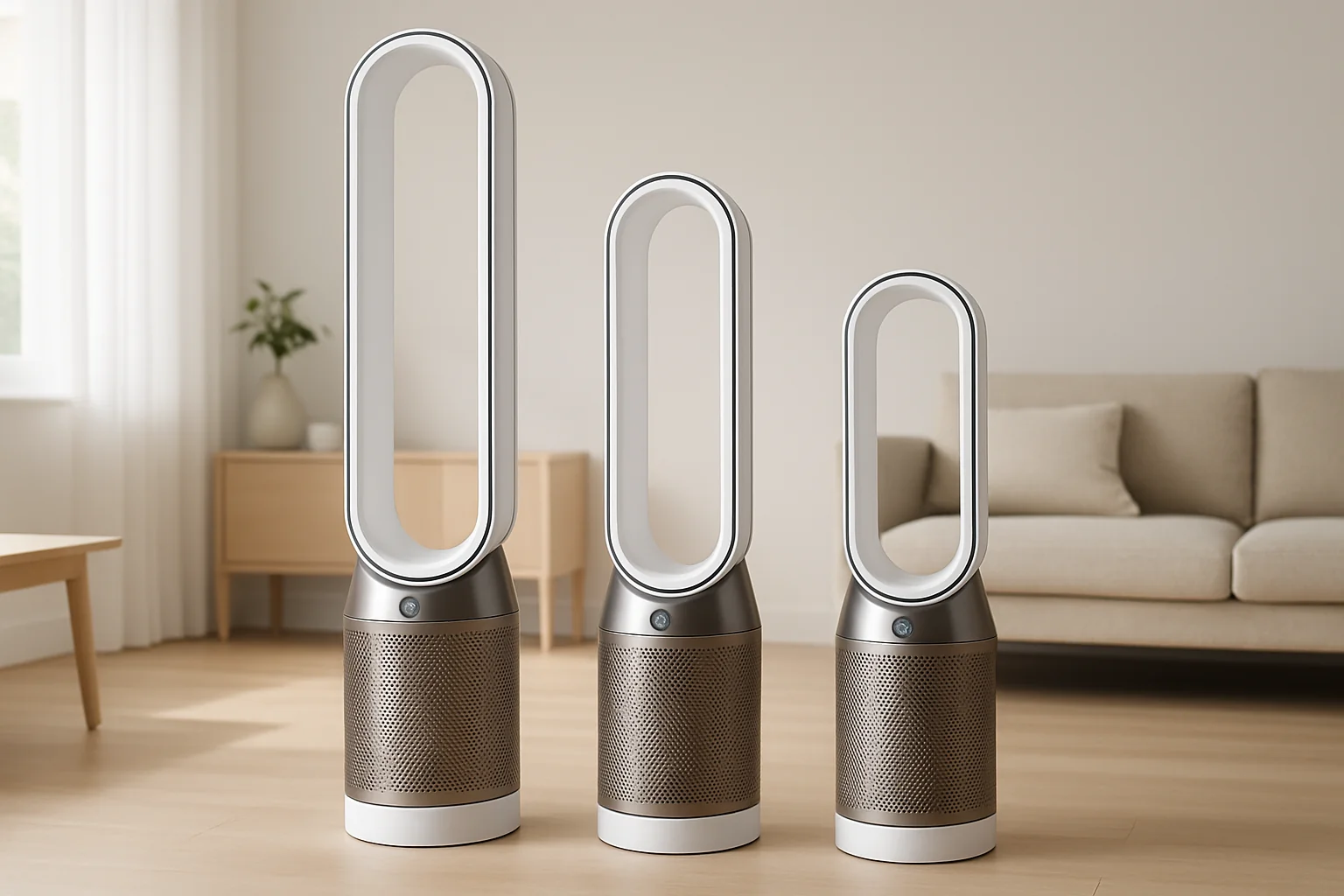
I bought my first Dyson purifier — a Hot+Cool — mostly for the heater. Two winters later, it's still running in my home office, and it's the machine that finally got me curious about what's actually going on under that bladeless shell. Once I started digging into the lineup — TP, HP, PH, BP, and now HJ — I understood why so many buyers get stuck at the model-number stage before they even get to the "is this worth it" question.
That's the real problem with shopping Dyson. The company sells one of the most recognizable air purifier brands on the planet, but its naming convention reads like an alphabet soup, and it refuses to publish the one number (CADR) every other brand uses to prove how well its machine actually cleans air. This guide untangles both issues: a plain-English decoder for every current and recent model, and a blunt answer to whether the design, the app, and the formaldehyde tech are worth paying two to four times what a Levoit or Coway costs.
We'll go tier by tier — Cool, Hot+Cool, Humidify+Cool, Big+Quiet, and the new compact HushJet — with the specs that matter, the filter costs nobody puts on the box, and a clear recommendation for who each model actually fits.
Dyson's Philosophy — Engineering Over Filtration Specs
Dyson's air purifier pitch has never really been about raw particle-cleaning power. It's about the fully sealed filtration system, the bladeless airflow, real-time air-quality data, and a level of industrial design most competitors don't even attempt. Every current model uses a HEPA H13 filter (or, on the newest compact model, an electrostatic equivalent) housed in a completely sealed unit, which prevents the air bypass that lets particles sneak around the filter media in cheaper machines. That sealed-system engineering is genuinely different from most of the competition — it's just not the same thing as having the highest Clean Air Delivery Rate (CADR) on the market, and Dyson doesn't publish CADR figures at all, preferring its own "whole-room" test instead.
Once you get past the marketing, the lineup breaks down into five families, plus a growing number of formaldehyde-focused and app-less budget variants layered on top. Here's the decoder:
| Code | Series | What it adds |
|---|---|---|
| TP | Purifier Cool | Purifies + bladeless fan cooling, no heat |
| HP | Purifier Hot+Cool | Purifies + cooling + up to 1500W heating |
| PH | Purifier Humidify+Cool | Purifies + cooling + humidifies (UV-C treated water) |
| BP | Purifier Big+Quiet | Large-room purifier with long-throw airflow, no heat/humidify |
| HJ | HushJet Purifier Compact | Newest, smallest, entry-tier purifier |
| "Formaldehyde" suffix | — | Adds a solid-state formaldehyde sensor + a permanent catalytic filter that destroys formaldehyde instead of trapping it |
| Gen1 / no app (e.g. HP10, TP10) | — | Stripped-down version with an LCD screen instead of app/WiFi/voice control |
Keep that table in mind while you read the rest of this guide — every model below fits into one of those five families.
Purifier Cool (TP Series) — Fan First, Purifier Attached
The TP line is Dyson's original bladeless purifier-fan hybrid, and it's still the volume seller in the lineup.
Dyson Purifier Cool TP07
The TP07 pairs a fully sealed 360° Combi Glass HEPA + carbon filter with 350° oscillation and ten speed settings, including a backward-airflow mode that diffuses air behind the machine instead of blasting it forward. It runs from roughly 35.5 dB at its lowest setting up to the mid-50s dB range at full power, and it's controlled through the MyDyson app or voice assistants.
What it doesn't have is a strong CADR result. Independent lab testing found the TP07 needed about an hour to fully clean a mid-sized room — noticeably slower than budget competitors that cost a fraction of the price. The Combi Glass HEPA and carbon filter is rated for about 12 months of use before replacement.
Pros
- Fully sealed HEPA H13 filtration, no bypass
- Backward airflow and Night mode for quieter overnight use
- App + voice control
Cons
- Particle-cleaning speed lags behind cheaper dedicated purifiers
- No formaldehyde detection or destruction
- Filter replacement runs more expensive than most competitors
Verdict: A well-built fan-purifier hybrid, not a particle-cleaning powerhouse. Buy it for the design and the fan function, not the fastest room clean.
Perfect for: Buyers who want a stylish bladeless fan that also filters air, and don't need heating, humidifying, or formaldehyde tracking.
→ Check the current price on Amazon
Dyson Purifier Cool Formaldehyde TP09
Same fan platform as the TP07, with one meaningful addition: a solid-state formaldehyde sensor paired with a permanent catalytic filter that chemically breaks formaldehyde down into water and CO2 rather than trapping and eventually saturating like a carbon filter would. The catalytic stage never needs replacing — only the HEPA + carbon combi filter does, on the same roughly 12-month cycle as the TP07.
Pros
- Formaldehyde detection most competitors don't offer at any price
- Catalytic filter is a genuine lifetime cost-saver on that specific pollutant
- Same fan performance and app features as the TP07
Cons
- Meaningful premium over the TP07 for a feature that only matters in specific homes
- Still not a particle-CADR leader
Verdict: The right upgrade over the TP07 specifically for anyone dealing with new furniture, fresh flooring, or recent renovation — the classic sources of household formaldehyde off-gassing.
Perfect for: New-build or recently renovated homes, new furniture owners, and anyone who wants ongoing formaldehyde tracking without buying test kits.
→ Check the current price on Amazon
Older Cool models worth knowing
The TP04 predecessor uses essentially the same CADR-equivalent rating as the TP07 but lacks backward airflow and formaldehyde sensing — only worth buying at a steep discount over the newer model. The first-generation Pure Cool Link (TP02/TP03) dates back to 2016, has weak particle-cleaning performance by modern standards, and stopped receiving firmware support years ago; treat it strictly as a heavily discounted or secondhand option, not a current buy.
Purifier Hot+Cool (HP Series) — Three Seasons in One Machine
The HP line takes the Cool platform and adds a heating element, turning the purifier into a year-round space heater and fan as well.
Dyson Purifier Hot+Cool HP07
The HP07 adds heating up to 1500W in 1-degree increments on top of the same sealed HEPA + carbon filtration and 350° oscillation as the TP07. Tip-over and overheat protection plus cool-touch surfaces make it reasonably safe for households with kids or pets. One quirk worth knowing before you buy: heating mode can't be controlled through the app — that's a regulatory restriction, not a Dyson design choice — so you'll need the remote or onboard controls for heat.
Pros
- Genuine 3-in-1 replacement for a separate heater, fan, and purifier
- Space-saving footprint compared to running three separate appliances
- Same sealed filtration as the Cool line
Cons
- Heating draws meaningfully more power than purify-only mode
- App can't control heat settings
- No formaldehyde sensing on this variant
Verdict: A legitimately useful multi-season machine if you actually want to consolidate a heater and a purifier into one footprint — just budget for the electricity cost of running it as a heater.
Perfect for: Small bedrooms or home offices where a separate space heater and air purifier would otherwise compete for outlet and floor space.
→ Check the current price on Amazon
Dyson Purifier Hot+Cool Formaldehyde HP09
The HP09 stacks the formaldehyde sensor and permanent catalytic filter from the TP09 onto the heating platform, and adds a display that shows real-time PM2.5, PM10, VOC, NO2, and formaldehyde readings, with historical graphs available in the app. It's the most fully-loaded machine in the mid-size lineup — and the most expensive Hot+Cool variant. One operational detail matters here: the machine is designed to require the catalytic filter installed to run at all, so factor that into long-term maintenance planning.
Pros
- The most complete air-quality dashboard in the mid-size Dyson lineup
- Catalytic formaldehyde filter never needs replacing
- Full heat/cool/purify functionality
Cons
- Highest price point among the mid-size Hot+Cool models
- Overkill for buyers who don't care about granular air-quality data
Verdict: Built for data-driven households who want to actually see what's in their air, not just trust that a filter is working.
Perfect for: Anyone who wants heating, cooling, purification, and formaldehyde tracking in a single machine and is willing to pay for it.
→ Check the current price on Amazon
Dyson Purifier Hot+Cool Gen1 HP10
The HP10 strips out the app, WiFi, and voice control entirely, replacing them with an onboard LCD screen — and drops the formaldehyde catalytic filter in favor of standard carbon. What's left is the same heat/cool/purify function at a noticeably lower price than the HP07. If formaldehyde tracking or smart-home integration matters to you, this isn't the right machine; if you just want Dyson's heating and cooling functionality without paying for the smart layer, it's the more sensible buy.
Pros
- Lower entry price into the Hot+Cool platform
- Simpler operation with no app dependency
- Quieter than the formaldehyde variant in independent measurements
Cons
- No app, WiFi, or voice control
- No formaldehyde sensing or destruction
Verdict: The pragmatic choice for buyers who want Dyson's heat/cool/purify function without paying for smart features they won't use.
Perfect for: Budget-conscious buyers who still want Dyson build quality and don't care about app control.
→ Check the current price on Amazon
Purifier Humidify+Cool (PH Series) — Adding Moisture to the Mix
Dyson Purifier Humidify+Cool Formaldehyde PH04
The PH04 is the three-in-one option: purify, humidify, and cool, minus any heating function. Its tank holds roughly five liters, good for around 36 hours of humidification, and Dyson runs the water through a UV-C treatment stage before it's released, which the company says kills the vast majority of bacteria in the tank. Like the TP09 and HP09, it carries the solid-state formaldehyde sensor and permanent catalytic filter. A periodic "Deep Clean" cycle is part of the maintenance routine, and one real limitation worth knowing up front: you can only run purify or humidify in automatic mode at a time, not both simultaneously optimized.
Pros
- UV-C treated water reduces bacterial buildup in the tank
- Formaldehyde detection and permanent destruction
- Genuinely useful for dry climates or winter heating season
Cons
- Maintenance (tank refills, Deep Clean cycles) is more hands-on than the other lines
- Auto mode only optimizes for one function — purify or humidify — at a time
- Below-average particle-cleaning speed relative to its price tier
Verdict: Worth it specifically for households that need real humidification alongside purification — it's a poor fit if you're buying it purely for air cleaning.
Perfect for: Dry-climate homes, winter dry air, or anyone who's currently running a separate humidifier and purifier and wants to consolidate.
→ Check the current price on Amazon
Purifier Big+Quiet (BP Series) — The Large-Room Flagship
Dyson Purifier Big+Quiet Formaldehyde BP04
The BP04 is Dyson's answer to open-plan living rooms and large bedrooms. Its cone-aerodynamics design projects purified air up to roughly 32 feet across a room, rated for spaces up to about 1,076 square feet. Filtration runs through a 360° HEPA H13-grade filter, a K-Carbon filter infused with potassium carbonate for stronger NO2 capture, and the same permanent catalytic formaldehyde filter used on the other Formaldehyde-branded models — plus a CO2 sensor that's exclusive to this version versus the non-formaldehyde BP03.
The genuine standout here is filter longevity: the HEPA stage is rated for up to five years, and the K-Carbon filter for around two, which meaningfully changes the cost-of-ownership math compared to purifiers that need new filters every six to twelve months. Independent smoke-CADR testing put the BP04 a bit behind class-leading dedicated large-room purifiers, but its combination of long filter life, real long-throw airflow, and NO2/formaldehyde sensing is hard to find in a single machine at any price.
Pros
- HEPA filter rated up to five years — the best filter economics in the lineup
- Genuinely covers large, open floor plans
- CO2, NO2, VOC, and formaldehyde sensing in one machine
Cons
- Highest price point of any Dyson purifier
- Large and heavy compared to the rest of the lineup
- Smoke-particle CADR trails some dedicated large-room competitors
Verdict: The right buy if you need to cover a genuinely large or open space and want chemical-pollutant sensing most large purifiers skip entirely — just go in expecting flagship pricing.
Perfect for: Open-plan living rooms, large great rooms, and anyone prioritizing long-term filter cost over upfront price.
→ Check the current price on Amazon
HushJet Purifier Compact (HJ Series) — Dyson's New Entry Point
Dyson HushJet Purifier Compact HJ10
The HushJet is Dyson's newest and most compact purifier, built around a new star-shaped nozzle design rather than the Air Multiplier loop used on the rest of the lineup. Instead of a glass-fiber HEPA filter, it uses a fully sealed electrostatic filter rated to capture 99.97% of particles at 0.3 microns, paired with activated carbon — and Dyson rates that electrostatic media to last up to five years, similar in spirit to the BP04's long-life approach but in a much smaller, lower-priced unit. It runs as quiet as 24 dB in sleep mode and is rated for rooms up to roughly 200 square feet, with a PM2.5 laser sensor and app/voice control. Note that despite the "compact" branding, it's taller than a true desktop unit at just over 18 inches.
Pros
- Lowest entry price into the current Dyson lineup
- Five-year filter life dramatically cuts long-term running cost
- Very quiet at its lowest setting
Cons
- Limited to smaller rooms
- Electrostatic filter is a different (not HEPA-glass) filtration approach than the rest of the lineup
Verdict: The most sensible starting point if you want to try Dyson's filtration approach without the flagship price tag, especially for a bedroom or home office.
Perfect for: Bedrooms, home offices, and first-time Dyson buyers who want the brand's engineering without the premium-tier cost.
→ Check the current price on Amazon
Dyson vs. Levoit and Coway — The Honest Comparison
Here's the question every reader actually has: is Dyson's engineering worth paying two to four times what a Levoit or Coway costs for comparable air cleaning? The honest answer is nuanced, and it depends heavily on what you're optimizing for.
Independent lab testing has repeatedly found that Dyson's bladeless Air Multiplier design is a fan and circulation technology, not a filtration advantage — it doesn't clean air faster than a conventional-fan purifier with a comparable filter. In direct room-clearing tests, budget machines like the Levoit Core 300 and Core 600S have outpaced the Dyson TP07 at clearing the same test room, sometimes by a wide margin, despite costing a fraction of the price.
| Factor | Dyson | Levoit / Coway |
|---|---|---|
| Filtration housing | Fully sealed (no bypass) | Housing quality varies by model |
| Published CADR | Not published (uses proprietary test) | AHAM-verified, published |
| Raw particle-cleaning speed | Middling for the price | Often faster at a fraction of the cost |
| Formaldehyde detection/destruction | Available on "Formaldehyde" variants | Rare across the category |
| Multi-function (heat/humidify) | Available (HP, PH series) | Limited to specific niche models |
| App and real-time air data | Full-featured MyDyson app | Varies, generally simpler |
| Filter cost | Higher, except long-life BP/HJ filters | Generally lower, replaced more often |
| Design and build | Distinctive, premium | Functional, less distinctive |
So what is Dyson's real engineering edge? The fully sealed filter housing is genuine — it prevents the air bypass that plagues cheaper units with loose-fitting filters, and that's a real quality difference many budget purifiers simply don't have. Where Dyson consistently loses is pure CADR-per-dollar: for buyers whose only goal is removing the maximum particles per minute per dollar spent, a Coway Airmega AP-1512HH or a Levoit Core 600S will out-clean a similarly priced Dyson.
Where Dyson wins outright is the combination nobody else offers in one machine: heating or humidifying plus purification plus formaldehyde destruction plus a genuinely useful app, all wrapped in a design that doesn't look like an appliance. If any one of those secondary functions matters to you, the premium starts making sense. If you just want the cleanest air for the least money, it doesn't.
Which Dyson Should You Buy?
| If you want… | Get this |
|---|---|
| The best all-round Dyson purifier fan | Purifier Cool Formaldehyde TP09 |
| Heating plus formaldehyde tracking | Purifier Hot+Cool Formaldehyde HP09 |
| Heat/cool/purify without paying for the app | Purifier Hot+Cool Gen1 HP10 |
| Humidification alongside purification | Purifier Humidify+Cool Formaldehyde PH04 |
| Coverage for a large, open-plan room | Purifier Big+Quiet Formaldehyde BP04 |
| The cheapest, lowest-maintenance entry point | HushJet Purifier Compact HJ10 |
| The best particle-cleaning per dollar, full stop | Look outside the Dyson lineup entirely |
If none of Dyson's secondary functions — heating, humidifying, formaldehyde destruction, long-life filters — matter to you, a dedicated purifier from Levoit or Coway will clean air faster for meaningfully less money. Dyson earns its premium on the features around the filter, not the filter itself.
Frequently Asked Questions
Q: Are Dyson air purifiers actually worth the price?
Only for specific buyers. If you want a multi-function machine (heating, humidifying, or formaldehyde destruction), real-time air-quality data through an app, and premium design, the price is defensible. For pure particle-cleaning speed per dollar, dedicated purifiers from brands like Levoit or Coway consistently outperform Dyson at a fraction of the cost.
Q: Does Dyson's bladeless design actually clean air better than a regular fan-based purifier?
No. The bladeless Air Multiplier is a circulation and fan technology, not a filtration advantage. Independent testing has found no particle-cleaning benefit from the bladeless design itself — Dyson's real filtration edge is its fully sealed filter housing, which prevents air from bypassing the filter media, a common weak point in cheaper units.
Q: What does "Formaldehyde" mean in a Dyson model name?
It indicates the unit includes a solid-state formaldehyde sensor and a permanent catalytic filter that chemically breaks formaldehyde down into water and carbon dioxide instead of trapping it. Unlike the HEPA and carbon stages, this catalytic filter never needs replacing.
Q: Why doesn't Dyson publish CADR numbers for its purifiers?
Dyson uses its own proprietary "whole-room" test rather than the industry-standard AHAM CADR rating most competitors publish. Third-party labs have measured Dyson models independently, and those figures are generally in the middle of the pack rather than class-leading, which is part of why the company doesn't lead with them.
Q: Can I use third-party replacement filters in a Dyson purifier?
Third-party filters are available for most models and typically cost less than genuine Dyson filters, but they carry real risk — reported issues include filter-error warnings from the machine's sensor system and weaker seal integrity, which can undercut the benefit of Dyson's sealed-filtration design in the first place.
Q: Which Dyson model works best for a large or open-plan room?
The Purifier Big+Quiet Formaldehyde BP04 is built specifically for large spaces, rated to cover roughly 1,076 square feet with long-throw airflow. It also has the longest filter life in the lineup, with a HEPA stage rated for up to five years.
Q: Can a Dyson Hot+Cool model replace a separate space heater?
Yes, functionally — it heats up to 1500W and includes tip-over and overheat protection with cool-touch surfaces. Keep in mind heating mode can't be controlled through the Dyson app due to regulatory restrictions, so you'll need the remote or onboard controls to adjust heat settings.
Q: Should I buy an older or discontinued Dyson model like the TP04?
Only if it's heavily discounted relative to the current TP07 or TP09. Older models generally share similar core filtration performance but lack newer features like backward airflow and formaldehyde sensing, and the oldest units (like the first-generation Pure Cool Link) no longer receive firmware updates.
Conclusion
Dyson's air purifier lineup makes a lot more sense once you know what the letters mean: TP for Cool, HP for Hot+Cool, PH for Humidify+Cool, BP for Big+Quiet, and HJ for the new compact HushJet, with "Formaldehyde" marking the models that add a permanent catalytic filter on top. None of that changes the core trade-off — Dyson sells engineering, design, and multi-function convenience, not the fastest or cheapest particle cleaning on the market.
If you want a genuinely multi-purpose machine that heats, humidifies, or hunts down formaldehyde while looking good doing it, the current lineup has a model built for that exact need — the TP09 for an all-rounder, the HP09 for heat plus formaldehyde tracking, the BP04 for large rooms, or the HushJet for the lowest-cost entry point. If your only priority is cleaning the most air for the least money, that machine isn't in this lineup, and that's worth admitting before you spend Dyson money on a Dyson problem you don't actually have.