Disclosure: Some links in this article are affiliate links. We may earn a commission on qualifying purchases at no extra cost to you.
The first night I ran a "quiet" air purifier next to my bed, I lasted about forty minutes before I unplugged it. The box promised 24 decibels. What actually came out of the unit on anything but the lowest fan speed sounded like a box fan with a grudge. That gap between the number on the packaging and the number your ears actually register is, in my experience, the single biggest reason people buy an air purifier and then quietly stop using it after a week.
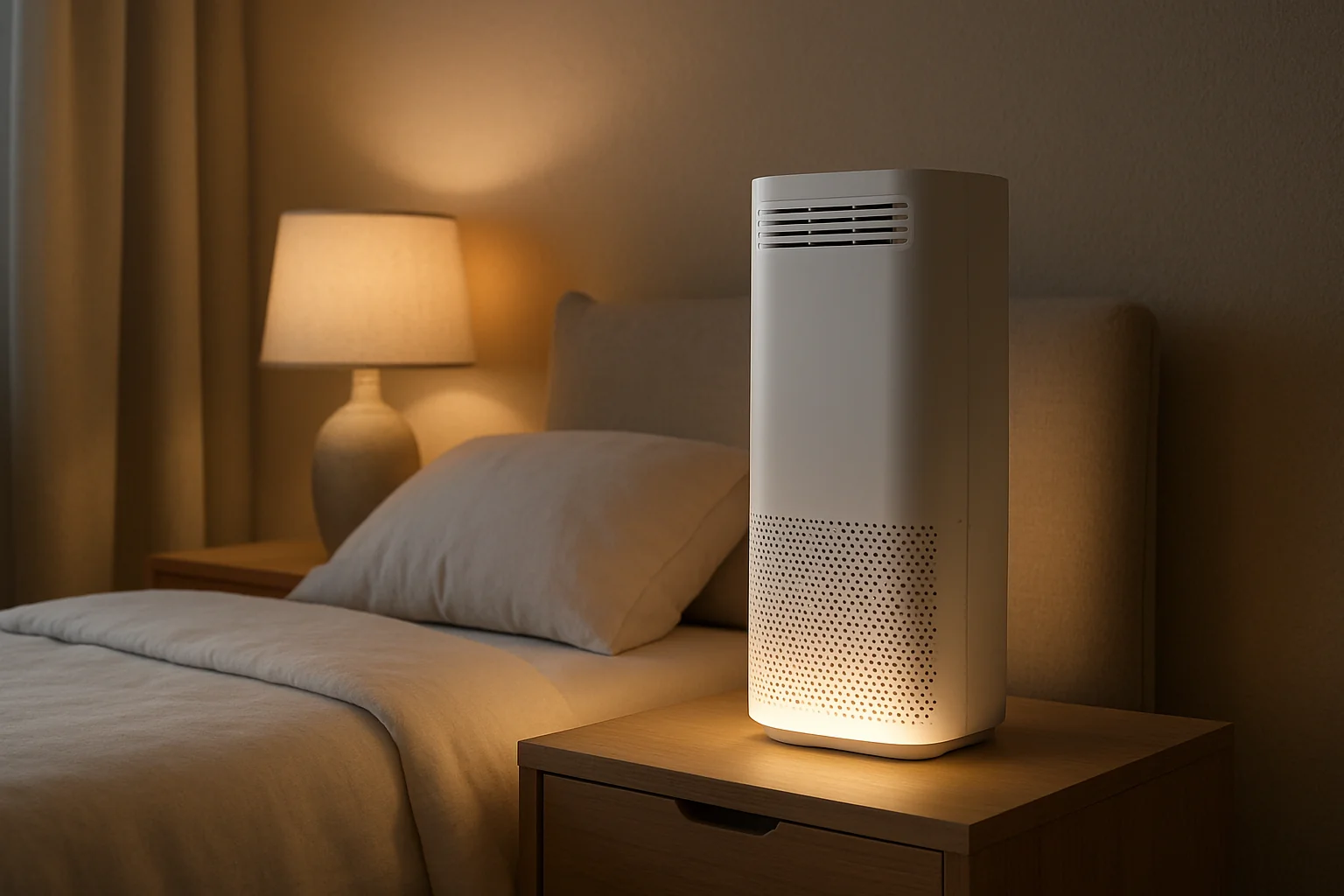
Bedrooms are a different problem than living rooms. In a living room, a purifier running at a moderate speed is background noise. In a bedroom, at 11 p.m., with the lights off and your brain trying to wind down, even a faint hum or a stray LED can be the difference between a purifier that runs all night and one that gets switched off the moment you get annoyed — which defeats the entire point of owning it.
This guide is built around that reality. Every pick below is chosen first for verified low-speed noise, second for whether it actually covers your room at a real air-change rate (not the inflated square footage on the box), and third for ongoing filter cost, since a $90 purifier that needs a $60 filter every four months isn't actually cheap. I've also flagged the recurring bedroom-specific annoyances — bright display lights, ionizers some people are sensitive to, and filters that clog faster than advertised — because those are the details that decide whether a purifier becomes part of your nightly routine or ends up in a closet.
Quick Picks
- Best Overall for Bedrooms: Levoit Core 300S / 300S-P — quiet, compact, lights-off sleep mode, easy on the budget
- Quietest Option: Blueair Blue Pure 511i Max — 19 dB at low speed, full display shutoff
- Best for Large Bedrooms: Levoit Core 400S / 400S-P — covers 400+ sq ft without getting loud
- Best for Pet Owners: Levoit Vital 200S / 200S-P — pet-hair intake design, no ionizer
- Most Proven / Best Track Record: Coway Airmega AP-1512HH Mighty — a decade of independent recommendations
- Best Budget Pick: Winix 5500-2 — strong CADR for the price, washable carbon filter
- Best Quiet Pick for Bigger Rooms: Blueair Blue Pure 311i Max — QuietMark-certified, low running cost
- Best Premium / Sleep-Focused: Alen BreatheSmart 45i — tuned pink noise, swappable filter types
What Makes a Great Bedroom Air Purifier?
A purifier that's great in a living room isn't automatically great next to your bed. Four things matter more here than anywhere else in the house.
Real low-speed noise, not the marketing number. Manufacturers almost always quote decibels at the lowest fan speed, in "sleep mode," measured close to laboratory-ideal conditions. Independent testers who put a decibel meter next to the same units at the same speeds consistently record higher numbers — sometimes by 15 dB or more. The World Health Organization's Guidelines for Community Noise set a bedroom target of 30 dB LAeq for continuous nighttime noise, and WHO/Europe recommends staying under 30 dB(A) at night for good sleep quality. Practically speaking: under 25 dB is close to inaudible, and anything under 40 dB is tolerable for most sleepers. Above that, you're negotiating with your own ears every night.
Room size that matches reality, not the box. The industry standard for sizing a purifier is CADR (Clean Air Delivery Rate), measured independently by AHAM in cubic feet per minute for smoke, dust, and pollen. The rule of thumb is roughly 4.8 air changes per hour (ACH) for a comfortable bedroom — take the AHAM smoke CADR, and match it to a room where that CADR covers the square footage at that rate. Manufacturers often print a much bigger square-footage figure on the box, calculated at just 1 ACH — technically true, practically insufficient for a room where you're breathing the same air for eight hours straight.
No unwanted nightlight. This one doesn't show up in spec sheets, but it's the most common real-world bedroom complaint: a bright status LED or air-quality ring that won't dim, sitting six feet from your face in an otherwise dark room. Whether a unit fully kills its display in sleep mode — versus just dimming it — matters more than most buyers expect until they've lived with one.
Filter cost you won't resent. A purifier that's quiet and well-sized but needs a $70 filter every four months adds up fast. Look at annual filter cost, not just the sticker price of the unit.
I'm also covering the ionizer question, because it comes up constantly with bedroom purifiers. Several models here (Winix, Coway) include an ionizer that can be switched off; a few others include one that can't be disabled. Ionizers add trace ozone, though CARB-certified units in this list stay well under California's 50 parts-per-billion limit. If you're ozone-averse or sensitive to it, I've noted which units let you turn it off entirely and which don't include one at all.
#1 Levoit Core 300S / 300S-P — Best Overall for Bedrooms
The Core 300S is the pick I'd point most people toward first, because it does the one thing a lot of "quiet" purifiers fail at: it actually goes dark and quiet in sleep mode. The display lights shut off completely after a few seconds, and the lowest fan speed sits around 22–24 dB — close enough to inaudible that it disappears into the background of a quiet bedroom.
It runs a straightforward three-stage setup — a nylon pre-filter, an H13-grade filter, and an activated carbon layer — good enough for everyday dust, pet hair, and general freshness, though it's not the pick for heavy smoke or strong odors. Worth noting: Levoit dropped the "True HEPA" label from this line after a 2023 advertising challenge from Dyson; the filtration itself hasn't changed, but the marketing language has, and I'm sticking to "high-efficiency filtration" rather than repeating a claim the brand no longer makes.
The VeSync app adds an auto mode driven by a PM2.5 sensor, which is convenient but worth watching — its "very good" air quality threshold is set well above the WHO's strictest guideline, so on auto mode it may tolerate air quality that's technically fine but not as clean as it could be. I'd recommend running it on a fixed low speed overnight rather than trusting auto mode blindly.
Specs
- Filtration: pre-filter + H13-grade filter + activated carbon (3-stage)
- CADR: ~141 CFM
- Recommended coverage: ~219 sq ft at 4.8 ACH
- Noise: 22–24 dB sleep mode / ~50 dB max
- Filter life: 6–8 months
Positioning: Budget-to-mid tier, sized for a standard bedroom.
Pros
- Genuinely quiet, with full display shutoff at night
- Compact footprint, easy to place on a nightstand or dresser
- Zero ozone, no ionizer to worry about
Cons
- Undersized for large bedrooms or primary suites
- Auto mode's air-quality threshold is more lenient than WHO guidance
- Not built for heavy smoke or strong odor loads
Verdict: The Core 300S is the purifier I'd recommend to someone who just wants clean air and a good night's sleep without overthinking it. It's quiet in the way that matters — at the speed you'll actually leave it running.
Perfect for: Standard bedrooms up to roughly 220 square feet, light sleepers, first-time buyers.
#2 Blueair Blue Pure 511i Max — Quietest Option
If noise is your only concern, this is the quietest unit in this roundup by a meaningful margin — 19 dB at its lowest setting, which is genuinely hard to detect in a normal bedroom. Blueair's night mode also fully shuts off the display rather than just dimming it, addressing the nightlight problem more thoroughly than most competitors.
The tradeoff is coverage: at 125 CFM CADR, this is sized for smaller bedrooms, roughly 190–240 square feet at a proper air-change rate. It uses Blueair's HEPASilent filtration — a hybrid of mechanical and electrostatic filtration that captures particles down to 0.1 microns — which is not the same certification as standard mechanical HEPA, but performs comparably in independent testing for typical bedroom particulates.
One thing worth flagging honestly: a small number of owners report an audible whir even at the lowest setting, and a mild odor from new filters that fades after a day or two of running. If you're extremely noise-sensitive, that's worth knowing going in, even though the specified dB rating holds up better than most in independent testing.
Specs
- Filtration: HEPASilent (mechanical + electrostatic) + carbon
- CADR: 125 CFM (AHAM-verified)
- Recommended coverage: ~193–237 sq ft at 4.8 ACH
- Noise: 19 dB low / 48 dB high
- Filter life: 6–9 months
Positioning: Mid tier, best suited to smaller or medium bedrooms.
Pros
- Lowest verified low-speed noise in this roundup
- Full display shutoff in night mode, not just dimming
- Zero-ozone certified, Energy Star Most Efficient
Cons
- Limited coverage for larger rooms
- A minority of owners report faint audible whir even at lowest setting
- Weaker on strong odors than pellet-carbon competitors
Verdict: For a smaller bedroom where noise is the deciding factor, this is the pick — it disappears into the background in a way most "quiet" purifiers only claim to.
Perfect for: Light sleepers in bedrooms under roughly 240 square feet.
#3 Levoit Core 400S / 400S-P — Best for Large Bedrooms
Primary bedrooms and larger guest rooms push most budget purifiers past their comfortable range, and this is where the Core 400S earns its spot. It covers around 400 square feet at 4.8 ACH, with a 240-gram pelleted activated carbon filter that handles odor and light smoke noticeably better than the thinner carbon layers in smaller Levoit models.
Levoit rates sleep mode at 24 dB, but independent testing puts the real-world floor closer to 42 dB at the lowest speed — still reasonable for most sleepers, but worth knowing before you assume it'll be as quiet as the smaller Core 300S. It includes a laser PM2.5 sensor, auto mode, and a swappable Smoke Remover filter option for wildfire season, which is a genuinely useful upgrade path if you live somewhere smoke-prone.
I've had good luck with this unit in a 300-square-foot room during a smoke-heavy week — visible haze cleared within roughly an hour and a half on a mid fan speed, which tracks with the CADR on paper. The VeSync companion app pushes more promotional notifications than I'd like, which is a minor but recurring annoyance.
Specs
- Filtration: pre-filter + H13-grade filter + 240g pelleted activated carbon
- CADR: smoke 231 / dust 240 / pollen 259 CFM
- Recommended coverage: ~403 sq ft at 4.8 ACH
- Noise: 24 dB claimed / ~42 dB tested at low speed
- Filter life: ~8–12 months
Positioning: Mid tier, sized for large bedrooms and primary suites.
Pros
- Real coverage for rooms 350–400+ sq ft
- Swappable Smoke Remover filter for wildfire season
- Laser sensor gives more precise auto-mode readings than basic sensors
Cons
- Louder in real-world testing than the sleep-mode number suggests
- App is ad-heavy
- Pelleted carbon filter costs more than basic 3-stage replacements
Verdict: If your bedroom is on the larger side and a compact purifier just isn't keeping up, this is the size step-up that still keeps noise in a livable range.
Perfect for: Primary bedrooms 300–400 square feet, occasional wildfire smoke exposure.
#4 Levoit Vital 200S / 200S-P — Best for Pet Owners
Pet dander and hair clog standard front-facing pre-filters fast, which is the specific problem the Vital 200S is built around — its U-shaped air inlet pulls air from multiple angles instead of one flat panel, so it doesn't choke as quickly on fur. Coverage is strong for its size class, rated around 390 square feet at a comfortable air-change rate, with no ionizer at all — a plus if you're wary of anything that might unsettle a nervous pet or bird.
Levoit lists sleep mode as low as 23 dB, but independent measurement puts the real floor closer to 41 dB — a gap worth knowing about if you're deciding between this and the Core 300S based on noise alone. The washable pre-filter cuts down on how often you're buying full replacement filters, which helps offset the cost of pet ownership.
The one real durability concern worth flagging: a handful of owners with multiple pets have reported bearing or motor noise developing within six months to two years of daily use. It's not the majority experience, but it's consistent enough across reviews to mention, especially in multi-pet households running the unit at higher speeds continuously.
Specs
- Filtration: washable pre-filter + H13-grade filter + pelleted activated carbon
- CADR: smoke 250 / dust 254 / pollen 289 CFM
- Recommended coverage: ~390 sq ft
- Noise: 23 dB claimed / ~41 dB tested at low speed
- Filter life: 6–12 months
Positioning: Mid tier, built specifically around pet hair and dander.
Pros
- U-shaped inlet resists clogging from pet hair better than flat pre-filters
- No ionizer — one less variable around pets
- Washable pre-filter reduces filter replacement frequency
Cons
- Noise floor higher than the sleep-mode number suggests
- Some reports of motor/bearing wear in heavy multi-pet use
- Pricier than base Levoit models
Verdict: For a bedroom shared with a shedding dog or cat, the intake design alone makes this worth the step up from a standard model.
Perfect for: Pet owners in medium-to-large bedrooms who want ionizer-free filtration.
#5 Coway Airmega AP-1512HH Mighty — Most Proven / Best Track Record
I keep coming back to this unit because it's earned its reputation the slow way — through a decade of independent testing and real-world ownership, not a single viral review cycle. It's been named a top pick by major outlets for ten consecutive years, and the numbers explain why: 233–246 CFM CADR covering 361 square feet at 4.8 ACH, a washable pre-filter that cuts long-term filter costs, and a toggleable ionizer if you want the option without being forced into it.
Here's the bedroom-specific catch: Coway lists 24.4 dB at the lowest speed, but independent testers have measured closer to 38–39 dB at that same setting — a bigger gap than most competitors, and it lacks a dedicated sleep mode entirely, relying instead on an eco/auto setting. The bigger real-world annoyance, reported constantly across owner communities, is the air-quality indicator LED, which is bright enough to function as an unwanted nightlight. Newer units let you hold the ionizer button for three seconds to shut the light off; older units don't have that option built in, and owners resort to physically covering the LED.
None of that erases what this unit does well. The ionizer runs clean — measured ozone output sits around 9 parts per billion, comfortably under California's 50 ppb limit — and the washable carbon pre-filter means you're not buying a full carbon replacement every few months like you would with pelleted-filter competitors.
Specs
- Filtration: washable pre-filter + carbon deodorization filter + True HEPA + toggleable ionizer
- CADR: smoke 233 / dust 246 / pollen 240 CFM
- Recommended coverage: ~361 sq ft at 4.8 ACH
- Noise: 24.4 dB claimed / ~38–39 dB tested at low speed
- Filter life: HEPA ~12 months, carbon ~6 months
Positioning: Mid tier, long-standing reliability pick.
Pros
- Longest independent track record of any unit in this list
- Washable pre-filter and carbon layer reduce long-term filter cost
- Ionizer can be fully disabled
Cons
- No dedicated sleep mode
- Bright status LED is a common nightlight complaint on older units
- Noisier at low speed than the marketing number implies
Verdict: If you want the option that's been independently vetted the longest, this is it — just plan on dealing with the display light on delivery.
Perfect for: Buyers who prioritize proven reliability and don't mind a brief light-off adjustment.
#6 Winix 5500-2 — Best Budget Pick
For the price, the CADR-to-cost ratio here is hard to beat: 232–246 CFM across smoke, dust, and pollen, covering 360 square feet at 4.8 ACH, with a washable activated-carbon filter that keeps replacement costs down over time. It's a genuinely capable purifier for a bedroom of average size, and Winix has confirmed filter production for this line through 2032, so long-term parts availability isn't a concern even as newer models replace it on shelves.
The bedroom-specific quirks are worth knowing up front. Independent testing puts the low-speed noise around 40 dB — audible, though tolerable for most sleepers, and noticeably louder than the Levoit or Blueair options above. The PlasmaWave ionizer is the recurring flashpoint in owner reviews: some people run it constantly with no issue, others report headaches and switch it off — and it defaults back ON every time the unit is power-cycled, which catches people off guard after an outage or a plug change. There's also a light-sensor auto mode that forces the unit into near-off "sleep mode" the moment a room goes dark, which is convenient for some but frustrating if you wanted full auto-cleaning power overnight in a blacked-out room.
Specs
- Filtration: washable pre-filter + washable AOC carbon + True HEPA + toggleable PlasmaWave ionizer
- CADR: dust 243 / pollen 246 / smoke 232 CFM
- Recommended coverage: ~360 sq ft at 4.8 ACH
- Noise: ~40 dB at low speed
- Filter life: ~12 months (washable carbon)
Positioning: Budget-to-mid tier, strongest CADR-per-dollar in this roundup.
Pros
- High CADR for the price point
- Washable carbon filter reduces long-term cost
- Filter availability confirmed through 2032
Cons
- Louder at low speed than most competitors here
- Ionizer resets to ON after every power cycle
- Light-sensor auto mode can over-dim performance in a dark room
Verdict: The best value in this list if you're comfortable managing the ionizer setting and can live with a bit more low-speed noise.
Perfect for: Budget-conscious buyers who want strong CADR without paying a premium.
#7 Blueair Blue Pure 311i Max — Best Quiet Pick for Bigger Rooms
This is the middle ground between the compact 511i Max and a full premium unit: 250 CFM CADR covering roughly 387 square feet at 4.8 ACH, with the same HEPASilent hybrid filtration and QuietMark certification that Blueair's smaller models carry. At 23 dB low and never louder than 50 dB even at max speed, it holds noise down well for a unit this capable, and its night mode fully kills the display rather than dimming it.
Energy use is genuinely low — independent testing put running cost at around $2.42 a month at max speed, 24/7, which is a meaningful long-term saving if you plan to leave a purifier running continuously in a primary bedroom. The one recurring complaint worth flagging: a faint buzzing noise at max fan speed that some owners find irritating over time, even though the lower speeds run cleanly.
Specs
- Filtration: HEPASilent (mechanical + electrostatic) + carbon
- CADR: 250 CFM (smoke/dust/pollen)
- Recommended coverage: ~387 sq ft at 4.8 ACH
- Noise: 23 dB low / 50 dB high
- Filter life: 6–9 months
Positioning: Mid-premium tier, best for larger rooms without sacrificing quiet.
Pros
- QuietMark-certified, genuinely quiet at working speeds
- Full display shutoff, low energy cost
- Strong CADR for its size class
Cons
- Faint buzzing reported at max fan speed
- Weaker odor control than pellet-carbon competitors
- Pricier than base Levoit or Winix options
Verdict: If your bedroom is too big for the 511i Max but you still want Blueair's quiet operation, this is the natural step up.
Perfect for: Larger bedrooms where quiet operation still matters more than raw odor control.
#8 Alen BreatheSmart 45i — Best Premium / Sleep-Focused
The detail that sets this one apart isn't a spec — it's the tuned "pink noise" the fan produces at low speed, deliberately engineered rather than incidental. It's the kind of thing that sounds like a marketing gimmick until you actually sleep next to it; the low, steady whoosh reads more like a white-noise machine than an appliance, and it's genuinely liked by owners rather than just tolerated.
Underneath that, it's a serious piece of filtration hardware. The medical-grade H13 HEPA filter and four swappable filter cartridge options — allergen, chemical/VOC, pet/odor, and smoke — let you tune the unit to your specific bedroom problem rather than running a one-size-fits-all filter. The optional ionizer keeps ozone output below detectable thresholds when active, and can be disabled entirely.
The tradeoffs are cost, both upfront and ongoing. This is the most expensive purifier in this roundup, filter cartridges run higher than any competitor here, and the "lifetime" warranty is contingent on staying enrolled in Alen's filter subscription — worth knowing before you rely on that guarantee. It's also noticeably louder at high speed than the sound at low speed would suggest.
Specs
- Filtration: pre-filter + H13 medical-grade HEPA + swappable carbon cartridge (4 types) + optional ionizer
- CADR: dust ~208 CFM
- Recommended coverage: ~300–800 sq ft depending on ACH target
- Noise: 23 dBA low / 49 dBA high
- Filter life: 12–15 months
Positioning: Premium tier, built around sleep quality and filter customization.
Pros
- Genuinely pleasant low-speed sound profile, not just quiet — engineered
- Swappable filter cartridges let you target your specific problem (allergens, VOCs, smoke, pet odor)
- Ionizer can run at effectively zero ozone or be disabled
Cons
- Highest upfront and ongoing filter cost in this roundup
- Lifetime warranty requires staying on filter subscription
- Loud at high speed relative to its quiet low-speed reputation
Verdict: If budget isn't the constraint and you want a bedroom purifier that treats sleep as the primary design goal, this is the one built for exactly that.
→ Check the current price on Amazon
Perfect for: Buyers prioritizing sleep quality and filter customization over price.
Comparison Table
| Model | Positioning | Sleep-Mode Noise | Coverage / CADR | Ionizer | Rating |
|---|---|---|---|---|---|
| Levoit Core 300S/300S-P | Budget-mid | 22–24 dB | 219 sq ft / 141 CFM | None | — |
| Blueair Blue Pure 511i Max | Mid | 19 dB | 193–237 sq ft / 125 CFM | None | — |
| Levoit Core 400S/400S-P | Mid | 24 dB (~42 dB tested) | 403 sq ft / 231–259 CFM | None | — |
| Levoit Vital 200S/200S-P | Mid | 23 dB (~41 dB tested) | ~390 sq ft / 250–289 CFM | None | — |
| Coway AP-1512HH Mighty | Mid | 24.4 dB (~38–39 dB tested) | 361 sq ft / 233–246 CFM | Toggleable | — |
| Winix 5500-2 | Budget-mid | ~40 dB tested | 360 sq ft / 232–246 CFM | Toggleable | — |
| Blueair Blue Pure 311i Max | Mid-premium | 23 dB | 387 sq ft / 250 CFM | None | — |
| Alen BreatheSmart 45i | Premium | 23 dBA | 300–800 sq ft / 208 CFM | Optional | — |
Which Bedroom Air Purifier Should You Buy?
If you just want clean air and quiet sleep without overthinking it — the Levoit Core 300S covers a standard bedroom, disappears at night, and won't strain your budget.
If noise is your absolute top priority — the Blueair Blue Pure 511i Max is the quietest option here, provided your room is on the smaller side.
If your bedroom is large — step up to the Levoit Core 400S or the Blueair Blue Pure 311i Max, both of which hold noise down reasonably well while covering real square footage.
If you share the bed with a pet — the Levoit Vital 200S's intake design is worth the premium over a standard model.
If you want the most independently vetted option on the market — the Coway AP-1512HH has earned that reputation over a decade, light-LED quirk aside.
If budget is the deciding factor — the Winix 5500-2 delivers the strongest CADR per dollar here, as long as you're comfortable managing the ionizer setting.
If you want the best possible sleep experience and don't mind paying for it — the Alen BreatheSmart 45i's engineered pink noise and filter customization make it the pick for sleep quality specifically, not just air quality.
Frequently Asked Questions
Q: How quiet does an air purifier actually need to be for a bedroom?
Aim for something in the low-to-mid 20s dB range at its lowest usable speed, and treat manufacturer claims as a starting point rather than a guarantee. The WHO recommends staying under 30 dB(A) in bedrooms at night for good sleep quality; independent testing often shows real-world noise several decibels higher than the sleep-mode number printed on the box, so check third-party measurements when you can.
Q: Why do manufacturer decibel ratings differ so much from independent test results?
Manufacturers typically measure noise at the lowest fan speed, at a set distance, under controlled lab conditions — a real number, but the best-case scenario. Independent testers often measure at similar distances in real rooms and consistently record higher readings, sometimes by 10–15 decibels, at the same nominal fan speed.
Q: Do I need an ionizer in my bedroom purifier?
No — several strong options in this list, including the Levoit models, skip ionizers entirely. Ionizers add trace ozone, and CARB-certified units stay well under the regulatory limit, but if you're sensitive to ozone or simply prefer to avoid it, an ionizer-free unit removes the variable altogether.
Q: How big a room can a bedroom air purifier actually cover?
Match the unit's AHAM smoke CADR to your room size at roughly 4.8 air changes per hour, not the larger square-footage figure often printed on the box, which is typically calculated at a much lower 1 air change per hour. A 250 CFM CADR unit comfortably covers a room in the 380–400 square foot range at a proper bedroom air-change rate.
Q: Will "HEPA-type" or non-standard filtration actually work in a bedroom?
Standard True HEPA captures 99.97% of particles at 0.3 microns and remains the benchmark, but hybrid technologies like Blueair's HEPASilent — which combine mechanical and electrostatic filtration — perform comparably for typical bedroom particulates like dust, pollen, and pet dander, even though they aren't certified to the same mechanical HEPA standard.
Q: Why did some Levoit models stop using the term "True HEPA"?
Following a 2023 advertising challenge from a competitor, Levoit's parent company voluntarily discontinued certain HEPA-related marketing claims on select models, including the Core 300 and Core 300S. The underlying filtration hardware wasn't changed by that decision — only the label used to describe it.
Q: Is a bright display light really that big of a deal?
For a lot of owners, yes — it's one of the most commonly reported bedroom-specific complaints, particularly with units that use an always-on air-quality indicator LED. Look for models with a genuine night mode or display shutoff rather than just a dimming option before you buy, especially if you sleep in total darkness.
Q: How much should I expect to spend on filters per year?
Budget units typically run $15–50 a year in filter costs, mid-range purifiers $45–70, and premium models with specialized filter cartridges $70–120 or more. Factor this into the total cost before comparing purchase prices alone — a cheaper unit with frequent filter changes can cost more over two years than a pricier one with a longer filter life.
Conclusion
There's no single "best" bedroom air purifier — there's a best fit for your room size, your noise tolerance, and what's actually in the air you're trying to remove. What separates a purifier that earns its spot on your nightstand from one that ends up in storage almost always comes down to the details covered here: real low-speed noise instead of the marketing number, a display that actually goes dark, and CADR that matches your room at a proper air-change rate rather than the inflated coverage figure on the box.
For most bedrooms, the Levoit Core 300S hits that balance without asking you to compromise on price. If your room runs larger, or your priorities shift toward pets, wildfire smoke, or long-term reliability, the picks above are organized to get you to the right one quickly rather than making you guess. Whichever you choose, run it at the speed you'll actually tolerate all night — a purifier that gets switched off at 1 a.m. isn't protecting anyone.